Quick Answer: The best way to manage party RSVPs is with a single digital system — one place where all responses go, with automated reminders for non-responders and a built-in dietary requirements question. Send invitations 4–6 weeks before the party and set an RSVP deadline at least 2 weeks before the date. Avoid splitting responses across WhatsApp, email, and text — scattered information is how headcounts get wrong and allergens get missed. FunzEventz includes digital invitations with built-in RSVP tracking, dietary collection, and real-time guest counts — free to get started.
Still sorting your venue or caterer? Browse verified kids party venues and caterers near you on the FunzEventz Directory — search by location to find who’s available on your date.
You invited 30 people.
You expected maybe 20 to come.
You ordered food for 22, just to be safe.
Then… the day before the party — all 30 confirmed.
Or the opposite: you planned for 25, and 11 showed up.
Or the version that keeps parents up at night: someone mentioned a nut allergy in a WhatsApp message three weeks ago, it got buried under 200 other messages, and you never told the caterer.
RSVP management sounds like admin. It isn’t. It is one of the most consequential parts of party planning — and the part most parents handle with the least structure.
This guide fixes that.
Why Do Party RSVPs Go Wrong?
Party RSVPs go wrong because responses arrive through too many channels at once, with no central system to collect and track them.
A parent confirms via WhatsApp. Another replies to the paper invitation with a text. A third emails. A fourth tells you at the school gate. A fifth responds three days after your deadline, when you’ve already given final numbers to the caterer.
By the day of the party, your “confirmed guest list” is a mental calculation based on fragments of information across four different apps and two conversations you’re hoping you remembered correctly.
This is the standard experience. It does not have to be.
When Should You Send Party Invitations?
Send party invitations 4–6 weeks before the party date.
This is the window that gives parents enough notice to put the date in their diary, check their own plans, and respond — while keeping the party close enough in mind that they actually do respond.
What happens when you send too early (8+ weeks): Parents say yes in principle, then forget, then double-book, then you have to reconfirm everything closer to the date.
What happens when you send too late (under 3 weeks): Many families already have plans. Your guest list shrinks not because people don’t want to come but because you didn’t give them enough notice.
The sweet spot: 4–6 weeks out. Send on a Tuesday or Wednesday — not a Friday when it gets lost in weekend noise.
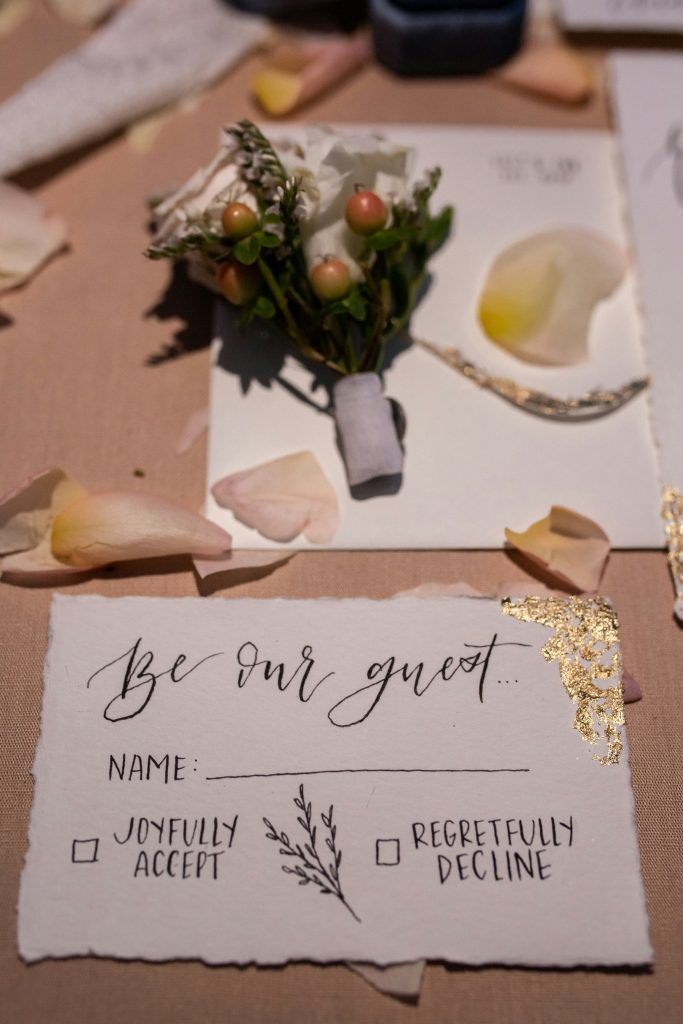
What Should a Party Invitation Include?
A party invitation should include seven pieces of information — no more, no less.
- The child’s name and age — whose party it is and what they’re turning
- Date and day of the week — both, to avoid confusion
- Start time and end time — parents need to know when to collect
- Full address — including postcode for map apps
- RSVP deadline — specific date, not “as soon as possible”
- Dietary and allergen question — required, not optional
- Contact details — for questions or last-minute changes
What to leave off: Dress codes (unless essential), requests for no presents (put this separately if needed), long descriptions of the entertainment. Keep it clean and scannable.
How Do You Set an RSVP Deadline That People Actually Respect?
Set your RSVP deadline 2–3 weeks before the party, and communicate it clearly — not as a polite suggestion but as a specific date.
Why 2–3 weeks: You need this time to give confirmed numbers to your venue, brief your caterer on dietary requirements, finalise party bag counts, and order anything that needs to arrive before the party. Last-minute RSVPs after this point create real logistical problems.
How to phrase the deadline:
Please RSVP by [specific date].
We need final numbers for catering by this date.
The words “we need final numbers for catering” change how people respond. It frames the deadline as practical, not arbitrary. Responses come in faster.
What to do with late RSVPs: Decide in advance. Either hold a small buffer (order for 2–3 more than your confirmed count) or set a firm cutoff after which you cannot accommodate additional guests. Both are reasonable. The key is deciding before the invitations go out, so you have a consistent answer when someone messages you on the day before the party.
What Is the Best Way to Track Party RSVPs?
The best way to track party RSVPs is with a single digital system that collects all responses in one place, updates in real time, and includes dietary and allergen information alongside each guest record.
What that looks like in practice:
- Every guest receives the same invitation link
- They confirm or decline through the link — not via WhatsApp, text, or word of mouth
- Their response — including dietary requirements — goes straight into your guest list
- You can see your current confirmed count at any time without doing a recount
- Automated reminders go to guests who haven’t responded
What most parents use instead: A group WhatsApp, a notes app, and a rough mental tally. This works until it doesn’t — and it stops working at the exact moment you need accurate information most.
How Do You Handle Non-Responders?
Send one reminder to non-responders 3–5 days before your RSVP deadline — not immediately after the invitation, and not repeatedly before the deadline.
The reminder message:
Hi [name] — just a quick reminder that RSVPs for [child's name]'s party
close on [date]. We need final numbers for catering, so please let us know
if [child] can make it. Looking forward to seeing you there!
Warm. Practical. One send.
After the deadline: If someone still hasn’t responded, you have three options:
- Chase once more — a direct message asking for a yes or no
- Assume decline — don’t cater or plan for them, and let the family know the deadline has passed
- Hold a small buffer — add 2–3 to your catering order to cover late confirmations
Most parents choose option 3 for peace of mind. It costs slightly more but removes the stress of last-minute additions.
How Do You Collect Dietary Requirements and Allergen Information Through RSVPs?
Collect dietary requirements and allergen information as part of the RSVP — not as a separate follow-up.
The moment a parent confirms their child is coming, they should be asked: “Does your child have any dietary requirements or allergies we should know about?”
This is not a nice-to-have. It is essential. One in fourteen children in the UK has a food allergy. In a party of twenty children, that is statistically one or two children whose safety depends on this information reaching your caterer, venue, and cake maker.
Why collecting at RSVP time matters:
If you send a separate message asking about allergies after RSVPs are in, response rates drop significantly. People have already responded to the invitation and don’t feel the urgency to respond again. Important information gets missed.
When the dietary question is part of the RSVP response — a required field, not an optional one — you get the information you need from every guest who confirms.
What to do with the information once you have it:
- Compile all dietary requirements in one list — name, requirement, severity if known
- Send this list to your caterer or venue in writing — not verbally — at least one week before the party
- Send it to your cake maker separately, specifically
- On the day, brief whoever is serving food on which child has which requirement
How Do You Give Final Numbers to a Venue or Caterer?
Most venues and caterers require final guest numbers 48–72 hours before the party. Put this date in your calendar the moment you book.
What to send:
Final guest count: [X] children, [X] adults

Dietary requirements:
- [Child name]: nut allergy (carries EpiPen)
- [Child name]: dairy-free
- [Child name]: vegetarian
- [Child name]: gluten intolerance

Please confirm receipt of this information.
Always ask for confirmation. If you don’t receive one, follow up. You want written confirmation that your venue has received and understood the dietary list — not a verbal acknowledgement that gets forgotten in a busy service.
How FunzEventz Handles RSVPs
Every part of this process — sending invitations, collecting RSVPs, chasing non-responders, gathering dietary requirements, and compiling the final guest list — is handled in one place on FunzEventz.
You create the event. Set your RSVP deadline. Send digital invitations with the dietary question built in as a required field.
As responses come in, your guest count updates in real time. Automated reminders go to non-responders before the deadline. Dietary requirements are stored against each guest — not buried in a message thread — and can be exported and sent directly to your venue or caterer in a single action.
No chasing. No cross-referencing three different apps. No morning-of-the-party panic about who mentioned a nut allergy three weeks ago.
75% of parents told us they needed more time and a way to keep costs under control. Spending an afternoon chasing RSVPs on WhatsApp is exactly the kind of thing that should not be eating into that time.
Frequently Asked Questions About Managing Party RSVPs
How far in advance should I send kids’ party invitations?
Send kids’ party invitations 4–6 weeks before the party date. This gives parents enough notice to confirm attendance and arrange plans, while keeping the party close enough in mind that they respond promptly. Sending too early — 8+ weeks — often leads to initial confirmations that fall apart as the date approaches. Sending too late — under 3 weeks — means many families already have conflicting plans.
What is the best RSVP deadline for a kids’ party?
Set your RSVP deadline 2–3 weeks before the party. This gives you enough time to confirm final numbers with your venue, brief your caterer on dietary requirements, and order anything that needs to arrive in advance. Frame the deadline clearly on the invitation as a specific date — “Please RSVP by [date]. We need final numbers for catering.” This phrasing generates significantly faster responses than a vague “please let us know.”
What do I do if people don’t RSVP to a kids’ party?
Send one reminder to non-responders 3–5 days before your RSVP deadline. Keep the message warm and practical — mention that you need final numbers for catering. After the deadline, chase once more with a direct yes-or-no question. If still no response, decide whether to hold a small buffer in your catering order or assume a decline. Most parents add 2–3 to their catering count as a buffer rather than chasing individual families repeatedly.
Should I ask about allergies on a party invitation?
Yes — always include a dietary and allergen question on your party invitation, as a required field rather than an optional one. One in fourteen children in the UK has a food allergy, and collecting this information upfront — as part of the RSVP — ensures you have accurate, complete information before you brief your caterer or venue. Sending a separate follow-up message about allergies after RSVPs are in results in significantly lower response rates.
How do I tell a venue about dietary requirements?
Send dietary requirements to your venue in writing — email or message — at least one week before the party. Include each guest’s name and specific requirement in a clear list. Ask for written confirmation that the information has been received and understood. Do not rely on a verbal mention during a phone call or site visit. Written confirmation creates a record that protects both you and the venue if something goes wrong on the day.
Is it rude to set an RSVP deadline for a kids’ party?
No — setting a clear RSVP deadline is considerate, not rude. It tells parents exactly when you need to hear from them and why. Venues and caterers require final numbers by a specific date; your RSVP deadline exists to meet that requirement. Parents who have hosted parties of their own will understand immediately. Frame it practically on the invitation and most parents will respond well within the window.
How do I manage RSVPs for a large kids’ party (20+ guests)?
For a large kids’ party, a digital RSVP system is essential. Tracking 20+ responses across WhatsApp, text, and email is genuinely unmanageable — responses get missed, dietary requirements get lost, and headcounts become unreliable. Use a platform that collects all responses in one place, sends automated reminders to non-responders, and stores dietary requirements against each guest record. FunzEventz is built for exactly this — digital invitations with integrated RSVP tracking, dietary collection, and real-time guest counts.
The RSVP chaos that feels like a normal part of party planning?
It isn’t normal. It’s just common.
A proper system turns two stressful weeks of chasing into a dashboard you check once a day and a clean list you send to your caterer.
That’s the version of party planning that exists. It just requires the right tools.
Create your free FunzEventz account — send digital invitations, collect RSVPs and dietary requirements automatically, and manage your guest list in one place.
Related guides:
- Kids Party Planning Guide — Every Step, In Order
- Kids Party Food Ideas and Allergen Guide
- Birthday Party Ideas for Every Age
Written by the FunzEventz team. Audra, Founder of FunzEventz, has spent hundreds of hours studying how parents plan and manage children’s celebrations and RSVP chaos is consistently the most stressful part of the process.
